Experimental Physics
Experimental Physics — Overview
Physics is not just about solving equations on a blackboard; it is an experimental science. To prove a theory, we must perform experiments and take measurements. However, no measurement in the real world is ever completely perfect.
Accuracy vs. Precision
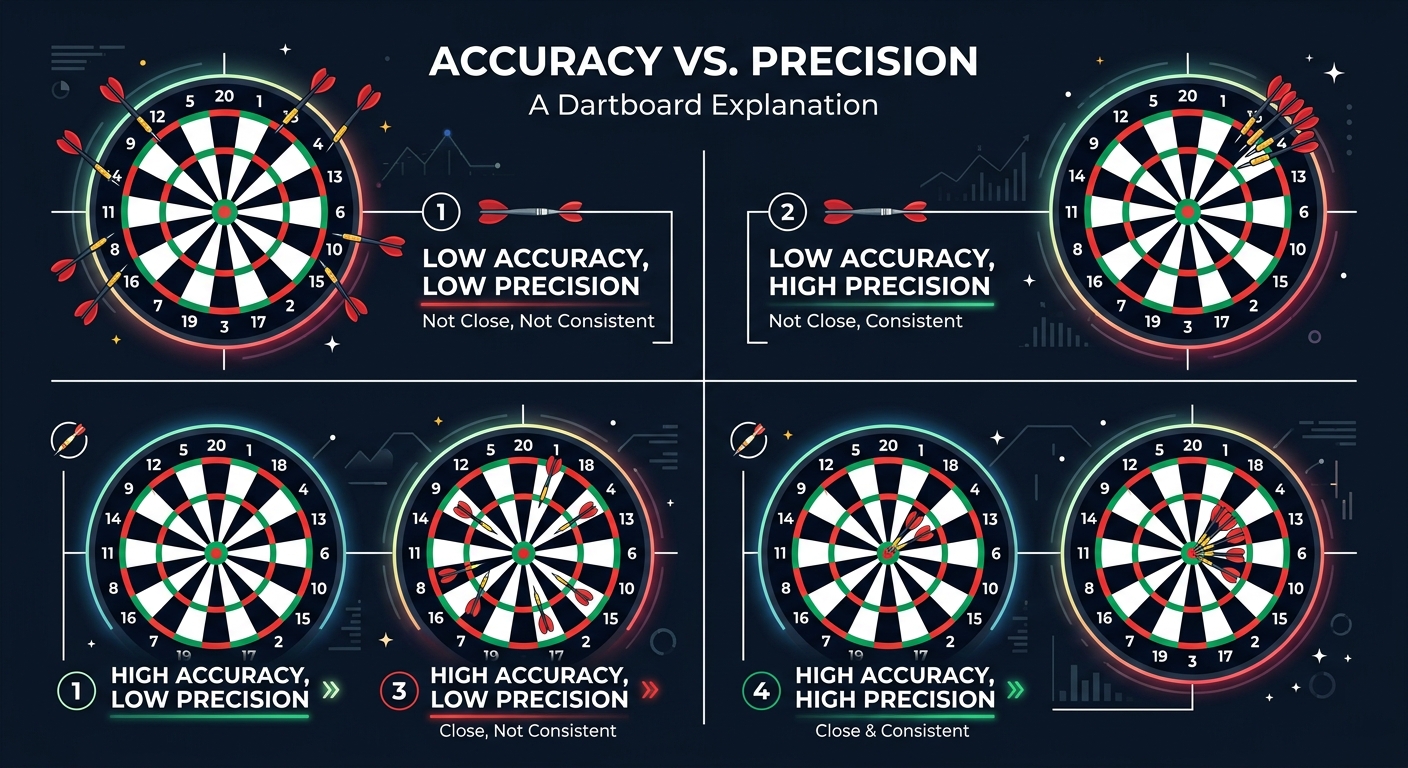
When we take measurements, we must understand two important concepts:
- Accuracy: How close your measurement is to the true, accepted value.
- Precision: How close a series of measurements are to one another, regardless of whether they are correct.
Significant Figures
To show how reliable our measurements are, we use significant figures. These are the digits in a number that carry meaningful information about its precision.
For example, if you measure a book's length with a standard ruler, you might write . The and are certain, while the is an estimate. Writing would imply your ruler is far more precise than it actually is.
Basic Rules for Counting Significant Figures:
- All non-zero digits are significant (e.g., has three).
- Zeros between non-zero digits are significant (e.g., has three).
- Leading zeros are not significant (e.g., has only two).
- Trailing zeros to the right of a decimal point are significant (e.g., has three).
To understand how these values are cataloged under standard systems of measurement, see the guide on Units and Dimensions.